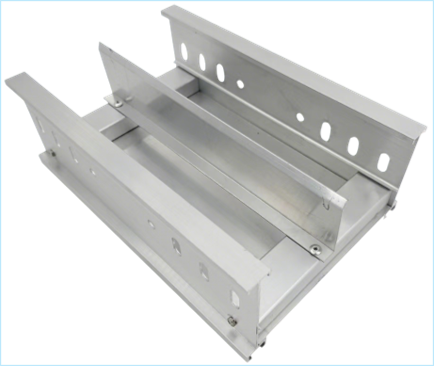
 Specification: 100x100x3000 mm
 Thickness: 1.2 mm
 Function maintenance: Trough cable tray, divider
 Color/Material: Anodized aluminum alloy
 Surface: Anodized

I. Product Description
The single-sided aluminum cable tray with an integrated partition is a lightweight, corrosion-resistant solution designed for specialized cable routing. It features a modular assembly—comprising side rails, rungs, and an aluminum alloy base—along with a unique single-sided design and an internal partition. This configuration is engineered specifically for corrosion-resistant cable management and the segregation of different types of cables. By leveraging the inherent advantages of aluminum alloy—namely its low weight and superior corrosion resistance—this product overcomes the drawbacks of traditional steel cable trays, such as susceptibility to rust and excessive self-weight. Furthermore, the integrated partition allows for the physical separation of high-voltage (power) and low-voltage (control/signal) cables, effectively mitigating signal interference. It is an ideal choice for environments prone to corrosion or projects requiring precise, segregated cable routing.
II. Key Advantages
Ultra-lightweight Aluminum Construction for Effortless Installation: As a lightweight, single-sided aluminum cable tray, it weighs 60% less than conventional steel alternatives. Its low self-weight makes handling and transport significantly easier, reducing the physical strain of installation—especially for high-altitude or long-run projects—thereby enhancing installation efficiency and improving on-site safety.
Inherent Corrosion Resistance for Harsh Environments: Aluminum alloy possesses natural anti-oxidation and anti-corrosion properties. Without the need for complex, additional anti-corrosive treatments, it remains stable in demanding environments—such as those exposed to salt spray, high humidity, or acidic/alkaline substances. It is highly resistant to rust and aging over long-term use, drastically lowering maintenance and replacement costs while offering far greater durability than standard steel cable trays.
Internal Partitioning for Signal Integrity: The system includes a dedicated, removable partition that allows for the physical segregation of power cables, control cables, and signal cables. This completely eliminates cross-interference between high-voltage and low-voltage lines, as well as signal crosstalk. It ensures the stable and precise transmission of low-voltage signals, meeting the rigorous standards required for sophisticated, segregated low-voltage cabling projects. Assembled structure with high adaptability and expandability: Utilizing a modular assembly process, this system features a neat, stable, single-sided configuration. It offers broad compatibility with various accessories and allows for convenient on-site assembly, disassembly, reconfiguration, and capacity expansion. Its flexible design accommodates complex routing paths, balancing practical installation requirements with ease of long-term operation and maintenance.
III. Applicable Scenarios
Suitable applications: Ideal for environments prone to corrosion or projects requiring precise cable segregation and routing. Common use cases include clean-room cabling in food processing plants, electromechanical cabling in water treatment facilities, installations in coastal areas (exposed to salt spray) or chemical plants (exposed to acids/alkalis), and outdoor photovoltaic power stations. It is well-suited for any integrated power and low-voltage cabling project that requires cable segregation, corrosion resistance, and lightweight construction.
Inapplicable scenarios: Not suitable for the installation of primary fire-safety trunk lines. Due to the limited fire-resistance properties of aluminum alloy, it cannot meet the fire-retardant regulatory standards required for primary fire-safety trunk lines; for such applications, specialized fire-rated steel cable trays are recommended.
IV. Structural Characteristics
Single-sided aluminum assembly—lightweight yet stable: Precision-assembled from side rails, rungs, and aluminum alloy base plates, this single-sided structure ensures uniform load distribution and high stability. It provides robust load-bearing capacity for standard cabling requirements while remaining lightweight, thereby reducing the structural load on the building framework and support/suspension systems.
Independent compartmentalized design for organized routing: Integrated partitions create distinct zones, allowing for strict separation between power cables and signal cables. This physically eliminates electromagnetic interference, ensures neat and tidy cable arrangement, and provides high clarity—meeting the requirements for high-standard, intelligent cabling projects.
Inherently corrosion-resistant material: Aluminum is naturally resistant to coastal salt spray, chemical acids and alkalis, and humid or aquatic environments. It remains durable and stable over long periods, resisting rust and damage even in harsh, corrosive industrial or outdoor settings. V. Specifications and Dimensions
Standardized Specification System: The trough-style, single-sided aluminum cable tray system with integrated partitions utilizes industry-standard dimensions. With a comprehensive range of specifications, selection is straightforward. The system is suitable for diverse applications—including photovoltaic (PV) installations, chemical processing, water treatment, coastal infrastructure, and food processing—and features highly interchangeable, universal accessories.
Precision Assembly: Components are engineered for high-precision fit, ensuring flat, uniform surfaces. Partitions align accurately and can be installed or removed with ease. The assembled system offers a clean, consistent appearance that meets the rigorous acceptance standards for high-precision mechanical and electrical engineering projects.
VI. Selection Guidelines
1. This trough-style, single-sided aluminum cable tray with partitions is a lightweight, corrosion-resistant solution designed for specialized cable routing. It is ideally suited for environments prone to corrosion or requiring high-precision cabling, such as coastal areas, chemical plants, water treatment facilities, food processing plants, and photovoltaic (PV) projects.
2. This system is the preferred choice for projects involving the co-routing of high-voltage and low-voltage cables—where there is a risk of signal interference—as well as for applications that prioritize lightweight construction and low maintenance costs.
3. This product has limited fire resistance; it must not be used for primary fire-safety (fire-rated) electrical circuits. For such applications, please use specialized fire-rated cable trays in accordance with project specifications and local fire safety regulations.

| Item No. | XC/B1A2-505AL | Mounting | Floor / ceiling / wall |
| Product Description | Anodized aluminum single-sided cable tray with divider | Walkable | No |
| Manufacturer | Tianjin Buerkafu International Trade Co., Ltd. | Cover | Yes |
| Coating | Anodic oxide film | Bottom mounting holes | Yes |
| Material | Aluminum alloy | Anti-rust treatment | No |
| Finish | Anodized | Side perforations | Yes |
| Finish Standard | GB/T 5237.1-2017 | Load test class acc. to IEC 61537 | Class II |
| Connectors included | Yes | Connection method | Bolted |
No documents in this category.