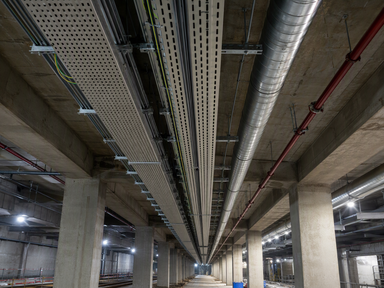
Project Name: Metro Manila Subway Project – Phase 1, Underground Stations
Product Scope: Perforated Trough Cable Trays, Supports and Pipe Clamps for MEP Routes
Project Status: In Progress | Delivery Year: 2026
Client/Owner: Department of Transportation (DOTr), Republic of the Philippines
Funding: JICA ODA loan
Supplier: Burkaf
The Metro Manila Subway is the Philippines’ first underground metro line, built by the Department of Transportation with JICA ODA financing. Phase 1 runs 13 underground stations through the densest part of the capital, with completion targeted for 2027 under the current programme.
Underground stations are the hardest environment in the network for cable containment. Every tray run sits inside a permanently damp box, shares a narrow ceiling void with ducts and pipes, and has to stay serviceable for decades without being opened. Burkaf supplies perforated trough cable trays, supports and pipe clamps for station MEP routes on this project.
Permanent Humidity Below Grade: Groundwater, ventilation air and cooling coils keep station ceilings damp year round. A tray that holds water becomes a corrosion point and a cable-damage point at the same time.
Seismic Design to NSCP: The Philippines sits inside the Philippine Mobile Belt. Station MEP supports must be anchored and braced against code-level ground motion without losing alignment across construction joints.
Ceiling Void Congestion: In a station ceiling, cable trays compete with supply and exhaust ducts, sprinkler mains and drainage. Support systems have to be coordinated in three dimensions, not added afterwards.
Fire and Life Safety Routes: Cable routes crossing evacuation paths must respect the fire separation the design specifies, and must stay accessible for inspection after handover.
Almost No Laydown Space: There is nowhere to stock material at station level. Deliveries must match the installation sequence station by station, in the order the ceilings are closed.
Burkaf is supplying perforated trough cable trays with supports and pipe clamps for the MEP routes of the underground stations.
1. Perforated Trough Profile: Drain and Ventilate at the Same Time
The solid base protects cable from dripping water and dust falling from the slab, while the perforations let condensate drain through instead of standing in the tray. Side perforations give ventilation through the run and a visual check of cable condition without lifting a cover.
2. Supports and Anchorage Engineered to Project Requirements
Support spacing, splice positions and bracing layouts are calculated against the seismic load cases the project specifies, with anchor capacities matched to the substrate and expansion provisions where a run crosses a construction joint. Calculation sheets and shop drawings are issued for review before production.
3. One Supplier for Trays, Supports and Clamps
Trays, brackets and pipe clamps come from the same production line, so hole patterns, finishes and dimensions are consistent along the route. That removes the usual interface argument between three suppliers when a support does not line up with a tray splice.
4. Documentation Built for a JICA-Funded Review
Each lot ships with mill certificates, coating measurement reports, load and deflection data and an installation guide — the document set a consultant needs to close an inspection without chasing the factory.
5. Delivery Sequenced to Station Handover
Because there is no storage at station level, production and shipping are planned against the station-by-station ceiling closure sequence, with material packed in handling-sized bundles for the site hoist.
Perforated trough trays, supports and pipe clamps have been delivered to station sites in scheduled batches, sequenced to the ceiling closure programme.
Every lot is inspected before shipment for dimensions, perforation pattern, weld quality and coating, with certificates issued per lot.
Burkaf is one of the cable containment suppliers on the project, working with the station MEP installation teams.
An underground station asks for two things that normally pull in opposite directions: a closed profile that protects cable from a wet slab, and open geometry that lets water out and air through. The perforated trough resolves that, and it only works if the support, the clamp and the tray are engineered as one system rather than bought separately.
The project also confirms what matters for Philippine infrastructure work: seismic bracing that follows NSCP and the project specification, and a documentation set complete enough for a JICA-funded review.
Burkaf – Cable Trays, Supports and Pipe Clamps for Underground Rail. Built for Wet Ceilings and Seismic Loads.