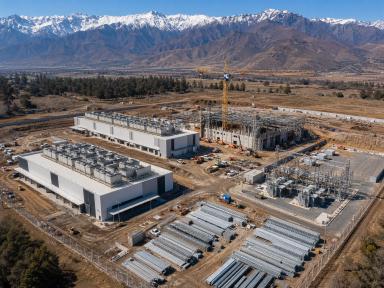
Project Name: Santiago Data Center Campus – Phase 1 (Quilicura, Metropolitan Region)
Product Scope: Hot-Dip Galvanized Perforated & Ladder Cable Trays, Seismic Bracing Systems
Project Status: In Progress | Delivery Year: 2026
Client/Owner: Project owner (name withheld under NDA)
EPC Contractor/Procurement: Main contractor (name withheld under NDA)
Supplier: Burkaf
Santiago has become one of Latin America’s fastest-growing data center markets. The Quilicura corridor concentrates the region’s hyperscale and colocation capacity, with short latency to the city, redundant grid feeds and international fiber landings.
Chile also sits on one of the most seismically active subduction zones in the world. Every non-structural system inside a data hall — including every meter of cable tray — has to stay anchored and functional under code-level ground motion. Burkaf supplies hot-dip galvanized cable trays and seismic bracing systems for the electrical infrastructure of this campus, engineered around both requirements at once.
High Seismic Demand: Chilean practice follows NCh2369 and NCh433 for non-structural components, while international colocation clients often specify ASCE 7 / IBC load cases. Tray runs must resist transverse and longitudinal seismic forces, inter-story drift, and the weight of fully loaded cable bundles, without losing electrical continuity.
Corrosion Protection Over a 20-Year Design Life: Outdoor routes, yard trays and generator-area runs face dust, winter humidity and repeated thermal cycling. Coating thickness and adhesion decide whether the system survives to the next refurbishment cycle.
Phased MEP Schedule: Data halls hand over one at a time. A supplier that ships the whole order at once creates site storage problems; a supplier that ships late stops commissioning.
Maintainability in a Live Facility: Once the hall is energized, adding or replacing a tray section has to be possible without touching adjacent circuits — which comes down to support design and joint detailing, not to price.
Burkaf is supplying hot-dip galvanized perforated and ladder cable trays, together with seismic bracing systems, for the electrical and low-voltage routes of this campus.
1. Hot-Dip Galvanized Cable Trays: Coating That Meets ISO 1461
Trays are hot-dip galvanized after fabrication to ISO 1461, with zinc coating averages in the 70–85 µm range depending on steel thickness. Coating thickness is measured per lot and reported before shipment, so the specified design life is verifiable rather than assumed.
2. Seismic Bracing Designed to Code, Not to Habit
Bracing layouts are engineered against the project’s specified seismic load cases (ASCE 7 / NCh2369), with transverse and longitudinal bracing at calculated spacing, anchor capacities matched to the concrete substrate, and expansion provisions where runs cross building joints. Load and deflection tables are issued as shop drawings for contractor review.
3. Engineered Support Spacing per IEC 61537
Support spacing, splice positions and deflection limits are calculated from the actual cable load, not from a default span. This keeps the tray within the deflection limit the client specifies and avoids re-work at installation.
4. Documentation That Passes Review
Each order is delivered with mill certificates, zinc coating measurement reports, load and deflection calculation sheets, and an installation and maintenance guide — the package a main contractor needs to close out an inspection.
5. Delivery Phased to the Construction Programme
Production and shipping are planned against the contractor’s hall-by-hall handover sequence rather than a single delivery date, so each batch arrives before its installation window and no batch arrives before there is space for it.
Hot-dip galvanized cable trays, supports and bracing components have been delivered to the Quilicura site in scheduled batches, matched to the hall handover sequence.
Every batch is inspected for dimensions, perforation pattern, weld quality and zinc coating thickness before shipment, with certificates issued per lot.
Burkaf is now one of the cable tray and seismic bracing suppliers on this campus, working directly with the project procurement and MEP teams.
A seismic zone and a long-life corrosion requirement in the same specification is where most cable tray offers fall apart: a light-gauge tray will not carry the bracing loads, and a heavy tray without proper coating will not last the design life. This project validates Burkaf’s ability to deliver structural capacity and corrosion protection in one system, documented well enough for a main contractor and an international colocation client to sign off.
It also confirms what matters for the Latin American market: engineering support and documentation in Spanish as well as English, and a supplier that can hold a phased delivery schedule across a multi-hall campus.
Burkaf – Cable Tray and Seismic Bracing Systems. Engineered for Seismic Zones, Delivered to Schedule.