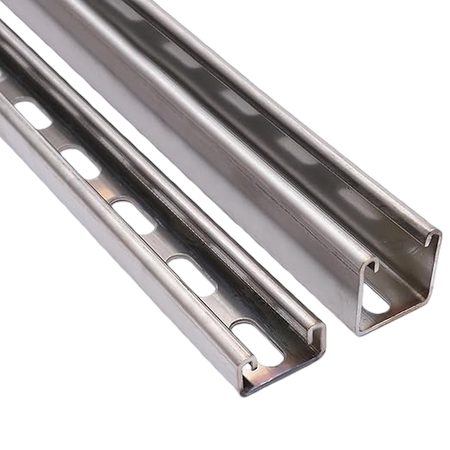
 Specification: 41x21D (mm)
 Function maintenance: Perforated C-channel
 Color/Material: Stainless steel
 Surface: Mill finish
C-Channel Steel – Product Description
C-channel steel (also known as C-profile steel or C-purlin) is a structural steel section with a C-shaped cross-section, manufactured via cold-forming processes from hot-rolled or cold-rolled steel sheets. It is one of the most widely used general-purpose profiles for cable tray support systems, industrial building structures, and equipment mounting frameworks. Its cross-section resembles the English letter "C," offering excellent mechanical properties and exceptional installation flexibility.
Structural Features:
C-Shaped Cross-Section: Composed of a web (the central vertical segment) and two flanges (the horizontal segments at the top and bottom). The edges of the flanges typically feature small inward or outward-facing lips (stiffeners), which further enhance the section's flexural rigidity and torsional resistance.
Pre-punched Holes: The web or flanges feature a series of uniformly spaced elongated or circular holes along the length of the profile, with standardized hole spacing (typically 50mm or 100mm). These pre-punched holes facilitate on-site bolting to accessories such as brackets, connectors, and suspension rods, eliminating the need for additional drilling or welding.
Section Range: Standard section heights typically range from 41mm to 120mm, with widths ranging from 21mm to 60mm, accommodating various load-bearing requirements.
Standard Lengths: Typically supplied in 3m or 6m lengths, or cut to specific customer requirements; longer lengths, such as 9m or 12m, are also available.
Key Advantages:
Superior Load-Bearing Capacity: Due to its high section modulus and moment of inertia, the C-shaped profile offers greater flexural and compressive strength compared to angle steel or round steel of the same weight, making it ideal for support structures subject to medium to heavy loads.
Highly Flexible Installation: The series of elongated holes along the length allows for the attachment of brackets, cross-braces, and other components at any desired position. This enables precise on-site adjustments based on cable tray elevations or equipment placement, and greatly simplifies future system expansions or modifications. Convenient and Efficient Installation: Utilizing standard bolted connections eliminates the need for on-site welding or cutting. This enhances installation efficiency, reduces labor costs, and avoids the safety risks associated with "hot work" (open-flame operations).
High Degree of Standardization: C-channel steel and its compatible accessories—such as brackets, connectors, spring nuts, and threaded rods—feature uniform mounting interfaces (e.g., the 41×41mm series is an internationally recognized standard size). This high level of component interchangeability simplifies procurement and replacement.
Flexible Configuration: C-channels can be combined back-to-back to form a box-like (rectangular) cross-section—increasing flexural strength—or face-to-face to form a square cross-section—enhancing torsional rigidity—to accommodate more complex load requirements.
Excellent Seismic Performance: When paired with seismic connectors and diagonal bracing, C-channel steel can form support systems for mechanical, electrical, and plumbing (MEP) installations that comply with seismic building codes. These systems are widely used in MEP engineering projects located in seismically active zones.
Materials and Surface Treatments:
Base Material: Typically Q235B or Q355B hot-rolled or cold-rolled steel; stainless steel or aluminum may also be used depending on specific requirements.
Pre-galvanized (Hot-dip galvanized sheet): Formed via cold-bending from pre-galvanized steel sheets, this option features a uniform, smooth zinc coating. It is a cost-effective choice suitable for general indoor environments.
Hot-dip Galvanized (Post-galvanized): The component is immersed in molten zinc after the forming process. With a coating thickness typically ≥65μm, it offers superior corrosion resistance, making it ideal for outdoor, humid, or industrial corrosive environments.
Electro-galvanized: Features a thin zinc layer applied via electroplating; suitable for light-load applications in dry environments.
Stainless Steel (304/316): Cold-formed from stainless steel sheets, this material provides exceptional corrosion resistance. It is well-suited for highly corrosive environments or areas with strict hygiene requirements, such as chemical plants, marine facilities, and food or pharmaceutical processing sites.
Powder Coating: An epoxy resin powder is applied over a galvanized base. Colors can be customized (typically based on the RAL color standard), providing both corrosion protection and an aesthetic finish. Typical Application Scenarios:
Cable Tray Support Systems:
Trapeze Hangers (Crossbars): Horizontal beams positioned beneath suspension rods to directly support cable trays.
Cantilever Arms (Brackets): L-shaped components fabricated from C-channel steel, used to support cable trays routed along walls.
Vertical Posts (Uprights): C-channel steel used either individually or in a back-to-back configuration to serve as vertical structural supports.
Gantry Frames: A portal-style support structure consisting of two vertical C-channel steel posts connected by a top crossbar.
Mechanical, Electrical, and Plumbing (MEP) Supports:
Hangers and brackets for air ducts, water pipes, and fire-protection piping.
Foundations and mounting brackets for equipment (such as fans, water pumps, and air-conditioning units).
Seismic bracing systems (lateral and longitudinal seismic supports).
Mounting structures for solar photovoltaic (PV) panels.
Building Structures and Industrial Applications:
Roof and wall purlins for industrial facilities.
Uprights and beams for warehouse racking/shelving systems.
Support structures for conveyor lines in automotive manufacturing and logistics sorting facilities.
Suspension systems for stage lighting and sound equipment.
Support structures for temporary construction platforms.
Ancillary Components:
Spring Nuts: Nuts designed to be inserted into the C-channel slot and locked in place by rotating 90°; they can be installed at any position along the channel when used with bolts.
Standard Nuts and Washers: Used for fastening connections at pre-drilled hole locations.
Connectors: Includes L-shaped, T-shaped, cross-shaped, and corner connectors, used for joining C-channel steel members either vertically or horizontally.
End Caps: Made of plastic or metal; used to seal the ends of C-channel steel, providing protection and an improved aesthetic finish.
Suspension Rod Connectors: Used to attach threaded suspension rods to C-channel steel crossbars.
Pipe Clamps and Saddles: Used to secure pipes to C-channel steel members.
Base Plates (Foot Plates): Used to anchor vertical C-channel steel posts to the floor or ground.
Diagonal Bracing Connectors: Used for attaching diagonal braces in seismic support systems. Installation Methods:
Suspended Installation: C-channel crossbars are suspended beneath the structural ceiling slab using hanger rods to support cable trays or conduits.
Wall-Mounted Installation: C-channel uprights or cantilever brackets are secured to a wall using expansion bolts, facilitating installations that run along the wall.
Floor-Mounted Installation: C-channel uprights are secured to the floor using base plates (foot plates).
Modular/Combined Installation: Multiple C-channel sections are joined using connectors to form a three-dimensional framework structure.
Extension/Joining: C-channel sections can be extended in length by connecting them—either end-to-end (butt joint) or by overlapping—using internal or external splice plates.

No documents in this category.